Is Face Paint Safe for Kids? What Non-Toxic Face Paint for Kids Really Means
Yes, face paint can be safe for kids when it's made for skin and used the way the label says. Pick a professional face paint whose colors are approved for...

Yes, face paint can be safe for kids when it's made for skin and used the way the label says. Pick a professional face paint whose colors are approved for cosmetic use, like a FAB face paint. Do a small skin test before the big day. Keep paint that isn't approved for the eye area away from the eyes, and wash it all off before bed. The word to be careful with is "non-toxic." On craft paint, it doesn't mean the paint was made for faces. Here's how to read a face paint label like a pro, in about five minutes.
What makes face paint safe for kids?
Three things matter most: the paint is made for skin, its colors are approved for the way you use them, and you follow the directions.
Professional face paint is a cosmetic. In the United States, the FDA says cosmetics and their ingredients don't need FDA approval before they go on sale. Color additives are the one exception. Every color in a face paint must be approved by the FDA for cosmetic use, and that includes theatrical makeup.
The FDA also decides where each color can go. A color that's fine on your cheek may not be approved near your eyes. That's why two face paints that look the same in the pot can carry different directions.
So a safe face paint for kids:
- Is sold as face paint or makeup, not as craft or poster paint.
- Lists its ingredients, including the names of its colors.
- Says on the label or product page how to use it, how to remove it, and whether it's OK near the eyes.
Good news for parents: professional brands spell this out on their product pages. FAB's pages, for example, say its colors contain only "FDA and EU compliant skin safe pigments and ingredients," and they wash off with soap and water on a soft cloth or sponge.
What does "non-toxic" mean on face paint?
This is where a lot of parents get tripped up. "Non-toxic" sounds like "safe for skin." On a craft paint, it means something else.
Paints sold for arts and crafts are art materials. Under a U.S. law called LHAMA, the CPSC requires art materials to get a toxicology review for chronic health hazards. After that review, the product carries a line like "Conforms to ASTM D-4236." That label is about art materials. On its own, it doesn't tell you a paint was made to wear on your face for hours.
The FDA's advice here is short: don't decorate your face with things that aren't intended for your skin. Acrylic and poster paint are made for paper and canvas. Skip them for faces, even when the bottle says non-toxic.
So when you shop for non-toxic face paint for kids, look past the word "non-toxic." Look for paint that is sold as face paint, lists its colors, and tells you how to use and remove it.
A quick word on "hypoallergenic." You'll see this word on some makeup. The FDA says there are no federal standards or definitions for it, so it means whatever a company wants it to mean. It's not a promise that your child won't react. A skin test is still the best check.
Is face paint FDA approved?
Not the way medicine is. The FDA doesn't approve finished cosmetics like face paint before they're sold. It does approve the color additives inside them.
So when you see "FDA compliant" or "FDA approved ingredients" on a face paint, the useful part is the colors. You want a paint whose colors are approved for cosmetic use on skin. Many professional brands say this on the product page. FAB, Mehron, Ben Nye, ProAiir and others list FDA compliance in their descriptions on SillyFarm.
Want to double-check a paint yourself? The FDA's tip is a little detective work:
- Read the ingredient list and find the names of the colors.
- Look them up in the FDA's Summary of Color Additives, in the section for cosmetics.
- Check whether each color is approved for use near the eyes. If it isn't, keep it away from the eyes.
If a color isn't on the list at all, the FDA says the company isn't obeying the law, and you shouldn't use it.
Are neon and glow-in-the-dark face paints safe for kids?
Some are, and many aren't made for skin at all. This is the one place where reading the label really counts.
The FDA approves only eight fluorescent colors for cosmetics. These are the bright "neon" colors that pop under a blacklight. None of the eight are allowed near the eyes. For glow-in-the-dark, only one color additive is approved, luminescent zinc sulfide, and only for limited use away from the eyes.
Many neon face paints use pigments outside that short list. Brands that sell them say so plainly:
- Global Colours says its neon colors "are made with pigments that have not been approved by the FDA to be used in cosmetics."
- Diamond FX says its neon collection is "labeled for use on hair and special effects only."
- TAG puts it right in the product name, like the TAG Bubble Gum FX split cake (Neon, Non-Cosmetic).

SillyFarm keeps these paints in a collection called UV Neon Face Paint (Non-Cosmetic). They're designed for special FX makeup, festivals and creative looks. For a child's face, choose a paint whose colors are approved for cosmetic use.
Want a glow for a blacklight party anyway? Some neon makeups are made to meet the rules. Kryolan says the newer formula of its UV-Cream Wheel is "FDA/EU compliant." The colors look a little softer in normal light than older neons, but they still glow under a blacklight. Even then, the FDA rule stands: no fluorescent color near the eyes.
How do you face paint a child safely?
These six steps come straight from the FDA's advice on face paint and novelty makeup, plus the directions on the products themselves.
- Test it first. A few days before the party, put a small dab on your child's arm. The FDA suggests leaving it for a couple of days to check for a reaction before it goes on the face. This matters most for kids with allergies.
- Follow the label. Use the paint the way the directions say. If a paint says it's not for use near the eyes, believe it, even when the photo shows paint around the eyes.
- Use the sniff test. The FDA says a very bad smell can be a sign that face paint is contaminated. Throw it out and use another one.
- Go easy around the eyes. Even products made for the eye area can irritate skin when you use too much. Keep lines thin and stay off the eyelids with any color that isn't approved there.
- Take it off before bed. Sleeping in makeup can irritate skin, and flakes can get into the eyes. Remove it the way the label says. Most water-activated face paint comes off with soap and warm water. Be gentle around the eyes.
- Know when to stop. If you see a rash, itching or swelling, wash the paint off. If it seems serious, call your doctor. You can also report a reaction to the FDA. They track problem products, and some face paints have been recalled in the past for causing rashes.
Doing SFX looks? Liquid latex is a great zombie tool, but it's a different product. Mehron's Liquid Latex Clear page says it contains natural rubber latex and may cause an allergic reaction. Skip it for anyone with a latex allergy, patch test first, and keep it away from the eyes, mouth, nose, ears, broken skin and hair.

Painting lots of kids? If you face paint at parties or school events, clean tools matter as much as the paint. Our guide to face painter hygiene covers keeping your kit clean between faces.
Start with a beginner kit
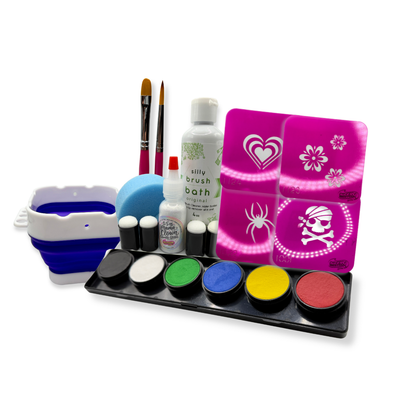
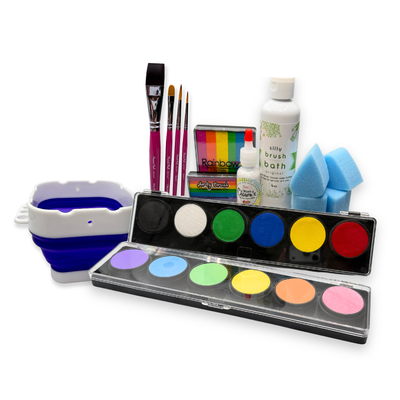
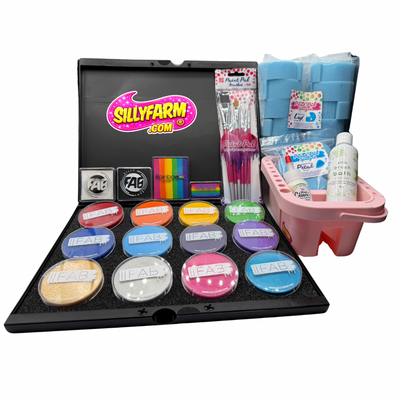
If you're painting your own kids at home, a beginner kit saves you from reading a dozen labels. The Halloween Face Painting Basics Kit is built around the FAB 6-Color Halloween Palette, plus a Candy Corn Arty Cake, three brushes, sponges, stencils, glitter and a collapsible water cup. For year-round painting, browse our beginner face painter kits.

New to all of it? Start with The Beginner's Guide to Face Painting, then read What Can You Use Face Paint On? for the full list of where paint can and can't go. Planning a costume? Our guide to the best face paint for Halloween costumes picks the right paint for every look.
Face paint safety FAQ
Is face paint safe for toddlers? Toddlers follow the same rules as older kids, with extra care. Use paint made for skin, test it on the arm first, keep designs small and away from the eyes, and wash it off before nap or bedtime. If your child has sensitive skin or allergies, ask your doctor before you paint.
Can I use acrylic paint on my child's face? No. Acrylic paint is an art material made for paper and canvas, not skin. Use face paint made for skin.
What does "Conforms to ASTM D-4236" mean? It means an art material has had a toxicology review for chronic health hazards, as the CPSC requires. It's an art-material label. On its own, it doesn't show that a paint was made for faces.
Is neon face paint safe for kids? Only some of it. The FDA approves eight fluorescent colors for cosmetics, and none of them near the eyes. Many neon paints are labeled non-cosmetic or for special effects only. Read the product page before it goes on a face.
Can kids sleep in face paint? It's best not to. The FDA says wearing makeup too long can irritate skin, and flakes can get into the eyes. Wash it off before bed.
How do I remove face paint from a child's face? Follow the label. Water-activated face paint comes off with soap and warm water on a soft cloth. Alcohol-activated paint needs the remover its maker recommends. Be gentle around the eyes.
Start with paint made for skin. Find a beginner kit and paint your first faces this weekend.